Throughout history, from the Middle Ages to the present day

Spiritual and national leaders across Europe have called their peoples to unite in prayer during critical moments of challenge and decision. These initiatives strengthened social cohesion, inspired hope and faith, and in certain instances played a significant role in events that shaped the destiny of nations and influenced the course of European history.

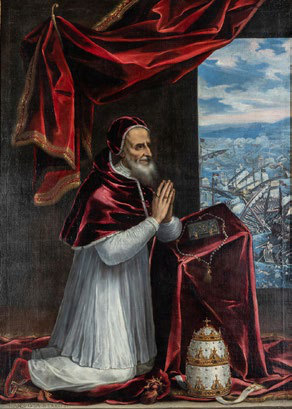
Pope Pius V, who called Europe to prayer before the Battle of Lepanto
1571

The Victory at Lepanto

Before the decisive battle between the Christian coalition and the Ottoman Empire, Pope Pius V called all of Europe to prayer.

The Holy League — the Papal States, Spain, Venice, Genoa and the Knights of Malta — was an alliance of powers that had spent the preceding decades at odds with one another. The Pope asked that, while the fleets sailed, churches across Europe keep the Rosary and that the faithful fast and pray for the outcome.

The victory at Lepanto on 7 October 1571 halted the Ottoman advance into the Mediterranean heart of Europe and was widely perceived as an answer to the united prayers of Christians across the continent. The date was afterwards kept as a day of thanksgiving, and the memory of a Europe that prayed together before it acted together outlived the alliance itself.
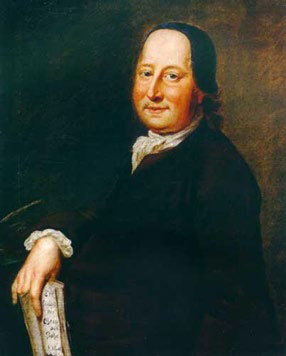
Count Zinzendorf of Herrnhut
18th–19th centuries

The Prayer Movement of the Moravian Brethren

A continuous prayer movement began in 1727 at the estate of Count Zinzendorf in Herrnhut, Germany.

Herrnhut was a settlement of refugees — Moravians, Lutherans, Reformed and Anabaptists who had fled persecution and who spent their first years there quarrelling. After a reconciliation among the community in August 1727, twenty-four men and twenty-four women agreed to divide the hours of the day between them so that prayer would never stop.

The prayer watch continued uninterrupted for more than a century and became a catalyst for spiritual renewal far beyond Saxony. Within five years the community was sending its first missionaries abroad; in time it laid the foundation for modern Protestant missions, shaped figures such as John Wesley, and profoundly influenced Christianity worldwide. It remains the clearest European example of what sustained, organised, shared prayer can set in motion.

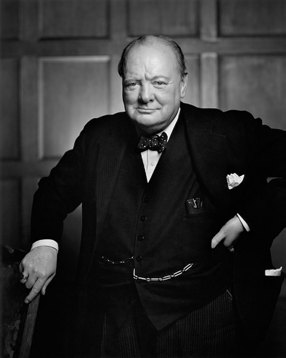
Winston Churchill, Prime Minister of Great Britain 1940–45
1940

United Kingdom — a story of victory

Four days after Winston Churchill took office as prime minister in May 1940, the nation was called to a day of prayer. On Sunday 26 May, King George VI led the country in prayer at Westminster Abbey; people across Britain flocked to local churches and chapels, concerned by news of the German advance on the British Expeditionary Force in Belgium and France.

The following day the evacuation from Dunkirk began. Over nine days some 338,000 British and Allied soldiers were brought home across the Channel — an outcome few had thought possible, and one the country received as an answer to its prayer. Further national days of prayer were called in each of the years that followed, and the memory of that Sunday shaped how a generation understood the war it had just survived.

“You ask me what our policy is? I say: to wage war by sea, by land, and by air, with all the might and power that God gives us; to wage war against a terrible tyranny, which surpasses all human crimes.” Winston Churchill
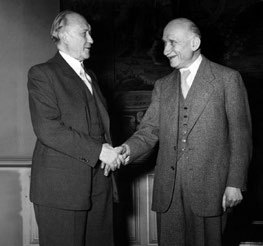
Robert Schuman and Konrad Adenauer
1950s

The foundation of the European Union

After the devastation of the Second World War, Europe lay in ruins. France and Germany, nations that had been adversaries for centuries, were searching for a path toward reconciliation.

Two Christian statesmen — Robert Schuman of France and Konrad Adenauer of Germany — were deeply committed believers. Before key meetings and important decisions they often prayed together, convinced that Europe’s future should be built not only on political and economic interests, but also on the Christian values of reconciliation, forgiveness and human dignity.

They were not alone. Alcide De Gasperi of Italy, the third of the founding statesmen, shared the same convictions; all three had lived through fascism, exile or imprisonment, and all three understood reconciliation as a moral undertaking before it was a political one. The Schuman Declaration of 9 May 1950 — now marked as Europe Day — proposed pooling the very industries that had armed the continent’s wars, so that war between France and Germany would become, in its own words, materially impossible.

The European Union was born not only at the negotiating table, but also through the shared prayers of Christian leaders who sought God’s wisdom for the reconciliation of the peoples of Europe.

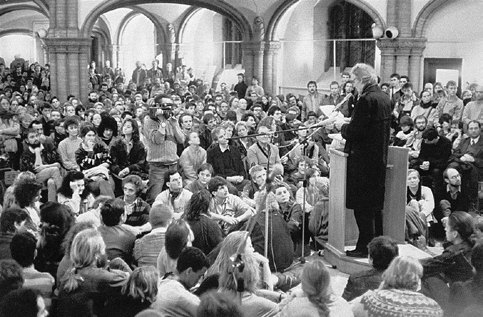
St. Nicholas Church in Leipzig
1982–1989

The Leipzig Peace Prayer Movement

The weekly Prayer Meetings for Peace and Freedom held at St. Nicholas Church in Leipzig, East Germany, became one of the defining spiritual forces behind the Peaceful Revolution of 1989.

For years the Monday prayers drew only a handful of people, watched closely by the state security service. By the autumn of 1989 the church could no longer hold them. On 9 October some seventy thousand people walked through Leipzig carrying candles, past troops and police who had been prepared for a confrontation that never came; a senior party official later admitted that the regime had been ready for everything except candles and prayers.

What began as a small prayer gathering grew into a nationwide movement that inspired peaceful civic action and helped bring about the fall of the Berlin Wall a month later, the reunification of Germany, and the restoration of freedom across Central and Eastern Europe after decades of communist oppression — without a shot being fired.

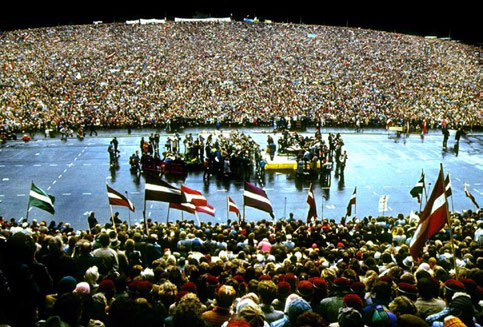
Mass gatherings of the Singing Revolution in the Baltic states
1987–1991

The Singing Revolution in Latvia, Estonia and Lithuania

The peaceful movement for independence was marked by mass gatherings where people sang in their native Baltic languages and prayed for freedom.

On 23 August 1989 roughly two million people joined hands in a single unbroken chain running six hundred kilometres from Tallinn through Riga to Vilnius — the Baltic Way. Churches that had spent half a century under official atheism opened their doors again, and prayer and song became the two instruments of a revolution that refused violence.

The movement united the peoples of the Baltic States, helping to restore their independence and inspiring a revival of faith, spiritual life and national identity that outlasted the political change itself.

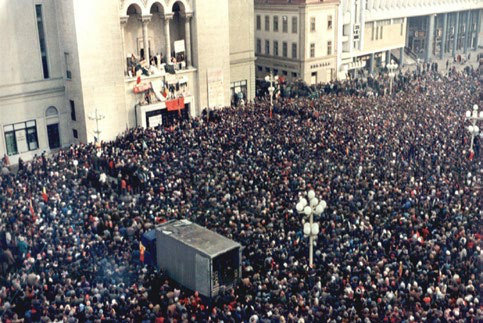
The Romanian Revolution of 1989
1989

Prayer and Christian resistance in the fall of Romania’s communist regime

The Romanian Revolution of 1989 began in Timișoara, where Pastor László Tőkés became a symbol of resistance.

When the authorities moved to deport him in December 1989, members of his congregation gathered outside his home to keep watch. Neighbours joined them, then strangers, then the city. Within days the protest had spread to Bucharest and the regime — the most repressive in the Warsaw Pact — had fallen.

Churches became places of prayer and peaceful protest, while faith inspired the moral awakening of society. After decades of communist atheism, Romania witnessed a significant spiritual revival alongside its return to freedom.

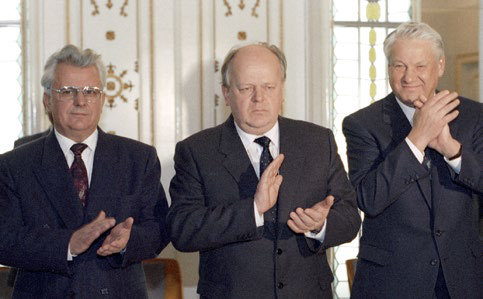
The collapse of the Soviet Union in 1991
1991

The collapse of the Soviet Union

Millions of Christians around the world prayed fervently for the fall of the Iron Curtain, the end of the Cold War, and the liberation of nations from totalitarian rule.

Across Western Europe and North America, congregations had kept this intention for decades — in many cases praying by name for churches and believers they had never met and could not contact. In the countries behind the Curtain itself, worship had continued in private homes, in forests and in prison camps.

The historic events that followed led to the collapse of the communist system, the dissolution of the Soviet Union, and the restoration of freedom for peoples who had longed for independence and the right to determine their own future for decades. Across the newly independent states, churches that had been closed for two generations reopened within months.

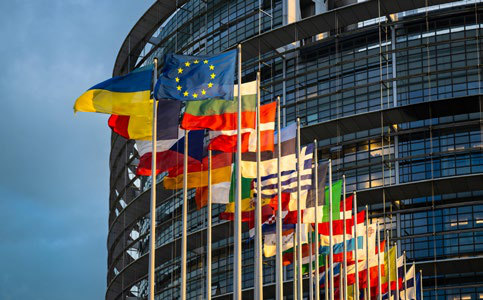
European flags in Brussels
1998

The European Prayer Breakfast

In 1998 a remarkable initiative was launched in Brussels, bringing together European leaders in prayer for peace, freedom and the future of Europe.

The gathering brings together members of the European Parliament, national parliamentarians, officials and church representatives across party lines and confessional divides — people who disagree in the chamber and who set that disagreement aside for the length of a breakfast. It has continued, in one form or another, ever since.

The European Prayer Breakfast stands as a powerful reminder that the strength of Europe lies not only in political cooperation and economic prosperity, but also in shared values, human dignity, spiritual wisdom and responsible leadership.

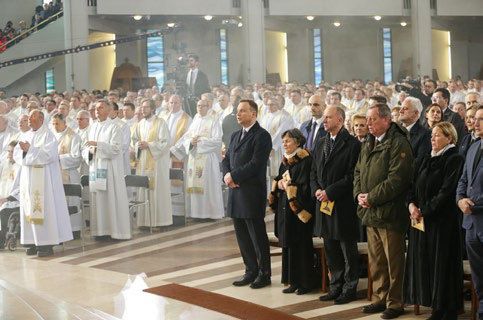
National spiritual event in Poland, 2016
2016

National spiritual event in Poland

On 19 November 2016 a solemn liturgy was held at the Shrine of Divine Mercy in Kraków, during which Polish Catholic bishops proclaimed Jesus Christ “King and Lord” and symbolically recognised Him as King of Poland.

The ceremony was attended by President Andrzej Duda and then-Prime Minister Beata Szydło, as well as tens of thousands of believers. The bishops and the believers present prayed together: “Jesus Christ, reign over us!” This important spiritual event influenced the development of society, culture and even the economy.

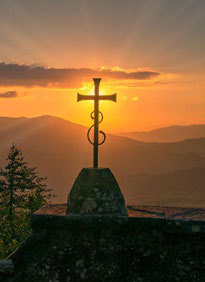
A cross against the sunset — prayer for Ukraine
2022 — present

Russia’s full-scale invasion of Ukraine

When many experts predicted that Ukraine would quickly fall, millions of people across Ukraine and around the world united in prayer for its protection and survival.

Churches of every confession opened as shelters, kitchens and collection points; congregations across Europe took in those who had to leave. Prayer for Ukraine became, for a time, one of the few things on which Christians across the continent spoke with a single voice.

Against all expectations, Ukraine endured and continues to defend its freedom and sovereignty. For many people of faith, the resilience of the Ukrainian nation stands as a powerful testimony to God’s guidance, protection and faithfulness during one of the greatest challenges in its history. It was out of those years that the first National Day of Prayer in Europe was written into law.

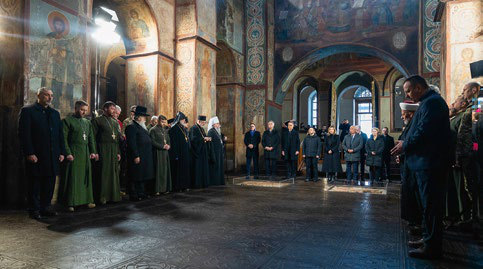
Interfaith prayer service at St. Sophia Cathedral in Kyiv
24 February 2026

Joint prayer by European leaders in Kyiv

The National Day of Prayer was first observed on 24 February 2025, within days of the law establishing it. A year later it drew Europe itself to Kyiv.

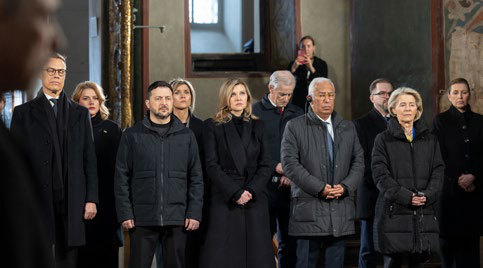
On 24 February 2026, on the National Day of Prayer, an interfaith prayer service was held at St. Sophia Cathedral in Kyiv, attended by President Volodymyr Zelenskyy and his wife Olena, together with high-ranking guests including European Commission President Ursula von der Leyen, President of the European Council António Costa, President of Finland Alexander Stubb, Prime Minister of Denmark Mette Frederiksen, Prime Minister of Estonia Kristen Michal, Prime Minister of Iceland Kristrún Frostadóttir, Latvian Prime Minister Evika Siliņa, Norwegian Prime Minister Jonas Gahr Støre, Croatian Prime Minister Andrej Plenković, Swedish Prime Minister Ulf Kristersson and Lithuanian Minister of National Defence. The prayer was led by bishops and leaders of churches and religious organisations.

It was the first official, intergovernmental prayer service of its kind in Europe — heads of state and government of several countries gathered not for a summit but to pray together, in a cathedral that has stood for nearly a thousand years.

“Today, within the walls of St. Sophia Cathedral in Kyiv, a united prayer for Ukraine was offered. For blessings and assistance for Ukrainian soldiers, for the release of prisoners of war, for every man and woman who was forced to leave their home, for all Ukrainians, and for unity and peace for the Ukrainian people.” President of Ukraine
European leaders at the prayer service in Kyiv

These stories represent only a small part of Europe’s rich spiritual heritage. Every nation can recall moments when, in times of uncertainty and challenge, people united in prayer, found renewed hope and courage, and witnessed events that shaped the destiny of their society and nation.

The National Days of Prayer Movement in Europe

Continue

The precedents are already in law

See how the United States and Ukraine established their National Days of Prayer — and the seven practical steps that follow.