Prayer first
Everything the movement does begins and ends with prayer for the nations of Europe — for their freedom, their peace and their common good.
A continent-wide initiative encouraging every European nation to set aside one day, in law, on which its people may pray together for their country.
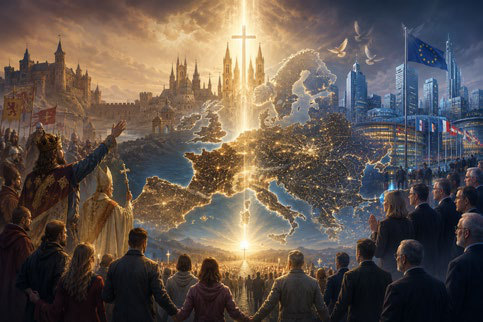
Who we are
The National Days of Prayer Movement in Europe brings together churches, religious communities, public figures and ordinary citizens around a single, simple aim.
We are not a denomination, a political party or a lobby group. We are a network of people convinced that the peoples of Europe are strengthened when they are able to pray together for their nations — and that a National Day of Prayer, recognised by the state, gives that prayer a shared date, a shared voice and a lasting place in public life.
Our work is interdenominational by conviction. In every country the initiative belongs to the local churches, communities and leaders of that nation; the movement offers the experience, the precedents and the practical framework that others have already tested.
What guides us
Everything the movement does begins and ends with prayer for the nations of Europe — for their freedom, their peace and their common good.
The initiative is open to all Christian confessions and, where nations choose it, to interfaith participation. Unity is the point, not uniformity.
We work through lawful, transparent parliamentary and governmental procedure, with full respect for constitutional order and freedom of religion.
Each National Day of Prayer belongs to its own nation — its date, its form and its language are decided locally, by local leaders.
A day of prayer is also a day of charity, compassion and service — its fruit is measured in the life of communities.
Materials, legal precedents and contacts are shared freely with anyone ready to carry the initiative in their country.
What we do
Europe’s history holds many moments in which united prayer preceded decisive change. The movement documents these stories, together with the legal texts and parliamentary procedures that turned a day of prayer into law in the United States and in Ukraine.
The movement introduces church leaders, parliamentarians and civic initiators to counterparts who have already walked this road, so that no national committee has to begin from a blank page.
From the first interdenominational meeting to the drafting of a legislative proposal and the celebration of the first National Day of Prayer, the movement offers a seven-step framework tested in practice.
Our board
The movement is guided by an international board drawn from across Europe and from the United States, where a National Day of Prayer has been established in law since 1988. Each member carries the initiative in their own country and answers for it there.
Brings the experience of Public Law 100-307 and of a National Day of Prayer observed annually since 1988.
Coordinates with churches and parliamentarians across Poland, Czechia, Slovakia and Hungary.
Heir to the Leipzig Peace Prayers; works with the German-speaking churches and with the European institutions.
Responsible for dialogue between Catholic, Orthodox and Protestant communities within the movement.
Accompanied the 2025 resolution of the Verkhovna Rada and advises national committees on legislative procedure.
Works with churches and public institutions across the British Isles and the Nordic countries.
Board members are confirmed country by country, and each name is published with that member’s consent. For correspondence with the board as a whole, write to info@nationaldayofprayer.eu.
These stories represent only a small part of Europe’s rich spiritual heritage. Every nation can recall moments when, in times of uncertainty, people united in prayer and witnessed events that shaped the destiny of their society.
From the movement’s brochure